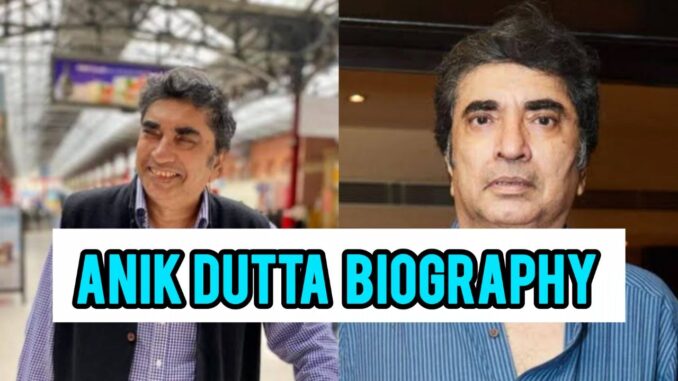
Anik Dutta Biography
Anik Dutta was born on May 22, 1961, in Kolkata, West Bengal, India. He was one of the most respected and intellectually gifted Bengali film directors, screenwriters, and satirists of his generation. Anik Dutta was a renowned screenwriter, and satirist from Kolkata, India, best known for directing Bhooter Bhabishyat (2012) and Aparajito (2022). He was a grandnephew of legendary filmmaker Bimal Roy. Anik Dutta was 65 years old as of 2026.
He came from a distinguished Bengali family. His grandfather, Narendra Chandra Dutta, was the founder of the United Bank of India — a detail that speaks to the intellectual and professional pedigree of the family he was born into. Even more notable is his family connection to cinema: Anik Dutta was a grandnephew of legendary Indian filmmaker Bimal Roy, whose work left a lasting mark on Hindi and Bengali cinema. It is no surprise, then, that Dutta grew up with a deep reverence for the art of filmmaking.
Before stepping behind the camera as a film director, he spent a significant part of his career in advertising. This background in commercial creative work gave him a sharp eye for storytelling, timing, and dialogue. He was 65 years old at the time of his passing and had, in that span of life, built a filmography that Bengali cinema will not easily forget.
Anik Dutta Career
Anik Dutta came to film direction relatively late compared to many of his peers. Before his breakthrough, he attempted a film titled Jadubabur Natni, which unfortunately never released. But that setback did not stop him. In 2012, he directed Bhooter Bhabishyat, a film that would go on to change the conversation around modern Bengali commercial cinema. It was a rare kind of film — one that blended horror, comedy, political satire, and Bengali nostalgia into something that felt both entertaining and deeply meaningful. The movie became a cult classic and earned widespread critical acclaim.
Following this success, he directed Aschorjyo Pradeep in 2013, another film rooted in fantasy and social commentary that stayed true to his signature style. In 2017, he released Meghnad Badh Rahasya, a period drama that demonstrated his range as a filmmaker. Then came Bhobishyoter Bhoot in 2019, the much-anticipated sequel to his debut hit. This film, however, found itself at the center of political controversy in West Bengal. Reports suggested that the film faced unusual resistance in getting screenings, with many believing that political pressure was involved. Rather than silence him, the controversy only deepened his reputation as a filmmaker who refused to play it safe.
In 2020, he directed Borunbabur Bondhu, a social drama that earned him recognition at the Filmfare Awards East and from the West Bengal Film Journalists’ Association. Two years later, in 2022, he delivered what many consider his finest work — Aparajito. This biographical drama explored Satyajit Ray’s journey in making Pather Panchali and was received as a love letter to Bengali cinema. The film won national recognition and was praised extensively for its direction, screenplay, and emotional depth. Critics described it as a tribute not just to Ray but to every artist who dares to create something honest and brave in difficult circumstances.
His final film, Joto Kando Kolkatatei, was released in 2025. Actor Quazi Nawshaba Ahmed, who worked with him on this project, recalled that their bond formed in a deeply personal way. Dutta had reached out to her after reading open letters she had written for her late father on social media. He told her emotionally, “I contacted you only after reading the letters you wrote to your father. I feel like after I pass away, my daughter Rai will also write open letters for me like this.” Those words, delivered without knowing how soon they would prove prophetic, now carry a painful weight.
Dutta’s filmmaking style was unmistakably his own. He wrote intelligent, layered dialogue. He used satire as a scalpel, cutting through political hypocrisy and cultural pretension with precision. His films often explored the anxieties of middle-class Bengali life, the erosion of cultural traditions, and the quiet dignity of ordinary people navigating an increasingly chaotic world. Many cinephiles placed his storytelling in the tradition of Satyajit Ray — not imitative, but genuinely inspired by the same artistic DNA.
Writer-director Pratim D Gupta perhaps said it best: “He was one of the sharpest, most uncompromising filmmakers we had. In a business constantly driven by safe choices and market machinations, he genuinely didn’t care about playing the game.” That spirit — fearless, honest, artistically uncompromising — defined Anik Dutta’s career from beginning to end.
Anik Dutta Personal Life
Despite his intellectual outspokenness in public forums, Anik Dutta was by all accounts a deeply private man in his personal life. Neighbours at his residence in Hindustan Park, South Kolkata, where he lived for many years, described him as dignified, reserved, and warm-hearted. He was not the kind of person who sought out small talk or social attention, but those who did interact with him remember him as someone who acknowledged the people around him with genuine warmth. Anik Dutta was married to Sandhi.
He had been residing in a duplex apartment on the third and fourth floors of a six-storey building at 11, Hindustan Park, along with his wife, Sandhi. It was within that home that he made several of his most celebrated films, including Bhooter Bhabishyat in 2012, Aschorjyo Pradeep in 2013, Meghnad Badh Rahasya in 2017, Bhobishyoter Bhoot in 2019, Borunbabur Bondhu in 2020, and Aparajito in 2022. Reports indicate, however, that he moved out of the Hindustan Park flat sometime in the years that followed, reportedly after a fallout with his wife. He later relocated to another part of South Kolkata.
Actress Mumtaz Sorcar, who worked closely with him on Bhooter Bhabishyat, described him as a fatherly figure. “Anik da was probably not just a director; he was like a father to me, and I shared a very different kind of bond with him,” she said. Veteran actor Prosenjit Chatterjee, who had known him for many years, echoed this sentiment: “He was not only a good filmmaker but he was an extremely intelligent individual who could regale you with stories.” These testimonials paint a picture of a man whose warmth and depth were experienced most fully by those who were allowed close to him.
Dutta was ethnically Bengali Indian and, while he never publicly identified strongly with any religious affiliation, his work consistently engaged with the philosophical and cultural dimensions of Bengali identity. He was politically outspoken, openly critical of censorship and government influence in cinema, and aligned with left-leaning intellectual circles. Avik Sengupta, a neighbour, noted that “he did not hide his political leanings at a time when no one else dared to do so.” He is survived by his wife and their daughter, Rai.
Anik Dutta Death
Anik Dutta died on Wednesday, May 27, 2026, at the age of 65. He passed away after reportedly falling from the terrace of the building in Hindustan Park, South Kolkata, where he had previously lived. The fall left him with critical injuries, and he was rushed to a private hospital near Dhakuria. Despite efforts to save him, he was declared dead shortly after arrival.
The circumstances surrounding his death have prompted a police investigation. According to reports, investigators recovered a handwritten note from his home that read, “No one is responsible for this.” The police, however, have not officially confirmed the contents of the note or its implications. Separately, it has been reported that Dutta had been dealing with health complications for some time before his death. Whether those health issues played a role in what happened that day remains part of the ongoing investigation.
The cook at a restaurant next to the building recalled hearing a loud thud followed by shouting, only learning afterward that the filmmaker had fallen. Fans rushed to the spot upon hearing the news, unable to believe what had happened. Samik Roy, a fan from Deshopriya Park, said, “I am yet to come to terms with it.” The grief was immediate and widespread.
West Bengal political leader Suvendu Adhikari responded publicly, writing on X: “Saddened by the untimely demise of renowned filmmaker Anik Dutta. His contributions towards Bengali Cinema are priceless. I trust the Kolkata Police will investigate and unearth the mysterious circumstances shrouding his sudden death.” Industry colleagues including Arindam Sil, Srijit Mukherji, Abir Chatterjee, and Jeetu Kamal rushed to the hospital as news broke. Actor Badshah Maitra called it “a social loss” as much as a loss to cinema.
The investigation is still active as of the time of writing, and further details are expected to emerge in the days ahead.
Conclusion
Anik Dutta was more than a filmmaker. He was a voice — sharp, compassionate, and completely his own. From his breakthrough with Bhooter Bhabishyat to his celebrated tribute to Satyajit Ray in Aparajito, he gave Bengali cinema films that will continue to be watched, discussed, and loved long after his passing. He was a man who believed in truth — in his work, in his politics, and in the people he chose to keep close. The exact circumstances of his death are still being investigated, but what is already clear is the size of the gap he has left behind. Bengali cinema has lost one of its most fearless artists, and that loss will not be easy to measure.
FAQs
How did Anik Dutta die?
Anik Dutta died on May 27, 2026, after falling from the terrace of a building in Hindustan Park, South Kolkata. He was taken to a private hospital near Dhakuria but could not be saved. A police investigation is currently underway to determine the exact circumstances of his death.
What is Anik Dutta’s most famous film?
His most iconic film is Bhooter Bhabishyat (2012), which became a cult classic in Bengali cinema. His biographical drama Aparajito (2022), about Satyajit Ray’s making of Pather Panchali, is also considered one of his finest works.
Who are Anik Dutta’s surviving family members?
Anik Dutta is survived by his wife, Sandhi, and his daughter, Rai. He had been reportedly living separately from his wife in his later years.

Stella George is a writer who focuses on career opportunities for people from non-traditional backgrounds and rural or off-grid internet solutions. With 18 years of experience, she covers the latest trends in these fields and helps readers understand new opportunities and technologies in simple terms. Stella holds both a BSc and an MSc in Business Administration, which gives her strong knowledge in business, career growth, and modern workplace solutions.
Leave a Reply